
Rules & labels · Seafood
Best fish for pregnancy: low in mercury, high in omega-3
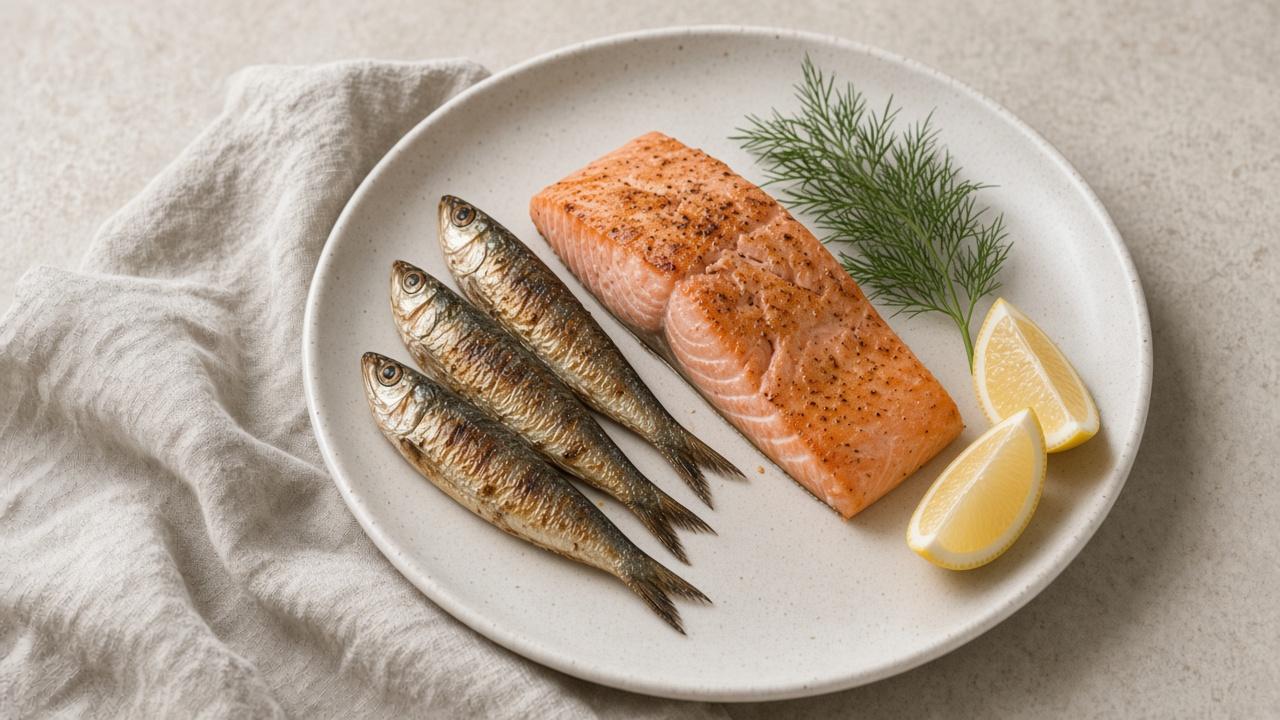
Anchovies, Atlantic herring, and salmon lead, with Atlantic mackerel and sardines close behind. All are FDA/EPA Best choices, far under the 0.15 ppm mercury line, and three 4-ounce servings a week supply at least 350 mg of EPA + DHA a day, the low end of what guidelines most often set for pregnancy.
Published · Sources checked 30 Sep 2026 · By Assize Index
Summary
- Background.
- FDA and EPA advise eating fish in pregnancy for nutrients that support a child’s brain development, and choosing fish lower in mercury.
- What we found.
- Among FDA/EPA Best choices on our table, anchovies and Atlantic herring supply over 650 mg of EPA + DHA a day on two 4-ounce servings a week; every fish in our top ten reaches at least 350 mg a day on three. Sablefish and albacore are rich in omega-3 but are Good choices, one serving a week; shrimp, tilapia, and cod are low in both mercury and omega-3.
- What it means.
- Small oily fish and salmon cover both the mercury line and the omega-3 figure. Low mercury alone doesn’t mean omega-3.
What FDA and EPA advise
FDA and EPA say fish provide key nutrients during pregnancy and breastfeeding that support a child’s brain development, starting with the omega-3s DHA and EPA1. Their advice for pregnancy and breastfeeding: a serving is 4 ounces, and you can eat two to three servings a week from the Best choices, or one from the Good choices1.
The categories follow average mercury. At or under 0.15 ppm a fish is a Best choice; up to 0.46 ppm it is a Good choice; above that it is a Choice to avoid2.
How much omega-3
A review of 42 national and international guideline documents found the most common figure is 250 mg of EPA + DHA a day for adults, with 100–200 mg more DHA in pregnancy3: 350–450 mg a day in all. Below, each fish’s EPA + DHA is averaged over the week, so it lines up with that daily figure.
Best choices richest in omega-3
| Fish | Mercury (ppm) | EPA + DHA a day, 2 servings a week | 3 servings a week |
|---|---|---|---|
| Anchovies, canned in oil | 0.016 | 666 mg | 999 mg |
| Atlantic herring | 0.078 | 653 mg | 979 mg |
| Chinook (king) salmon | 0.022 | 563 mg | 844 mg |
| Atlantic mackerel | 0.050 | 390 mg | 585 mg |
| Pink salmon, canned | 0.014 | 349 mg | 523 mg |
| Atlantic salmon, farmed | 0.022 | 324 mg | 486 mg |
| Sardines, canned in oil | 0.013 | 318 mg | 477 mg |
| Rainbow trout, farmed | 0.071 | 284 mg | 425 mg |
| Sockeye salmon | 0.022 | 278 mg | 417 mg |
| Mussels | 0.028 | 253 mg | 380 mg |
Two servings of anchovies, herring, or chinook salmon clear even the upper 450 mg. At three servings, the top of FDA and EPA’s range, every fish in the table reaches at least 350 mg, and all but trout, sockeye, and mussels reach 450 mg. Farmed coho salmon sits between chinook and mackerel.
Mercury comes from FDA’s species means4; EPA + DHA from USDA composition rows5, except farmed Atlantic salmon, from Norway’s food composition table6. Mussels are not on FDA’s list, so their mercury is the sample-weighted survey mean on the mussels page.
Rich in omega-3, one serving a week
| Fish | EPA + DHA (g/100 g) | Mercury (ppm) | FDA/EPA category |
|---|---|---|---|
| Sablefish | 1.79 | 0.361 | Good choice |
| Albacore tuna, canned | 0.86 | 0.350 | Good choice |
| Swordfish | 0.90 | 0.995 | Choice to avoid |
Sablefish carries nearly as much EPA + DHA as herring, but at more than twice the Best-choice line it counts as one serving a week in pregnancy, not two or three.
Low in mercury, low in omega-3
| Fish | EPA + DHA (g/100 g) | Mercury (ppm) | Two servings cover |
|---|---|---|---|
| Shrimp | 0.03 | 0.009 | 3% of 350 mg a day |
| Tilapia, farmed | 0.14 | 0.013 | 12% |
| Atlantic cod | 0.16 | 0.111 | 15% |
| Light tuna, canned | 0.22 | 0.126 | 21% |
These are Best choices on mercury and fine to eat, but they are not where the omega-3s are. Low mercury and high omega-3 are separate questions.
What this does not cover
- Your own plan. How much and how often is FDA and EPA’s call, and your clinician’s1. Not medical advice.
- Other nutrients. FDA also lists iron, iodine, and choline among the nutrients fish bring in pregnancy1. Our table does not score them.
- Dioxins and PCBs. They build up in oily fish, so herring, sardines, and mackerel sit near the top of the dioxins + PCBs chart. Our Pregnancy & kids list keeps only fish at or under 0.15 ppm mercury, then ranks them with EPA + DHA in front and mercury, sodium, and dioxins + PCBs weighted up (see Methods).
Table impact
None. Every figure here is already a cell on the seafood table. This entry reads the mercury and EPA + DHA columns side by side against FDA/EPA’s pregnancy advice.
On our tables
References
- FDA / EPA. Advice about Eating Fish: For Those Who Might Become or Are Pregnant or Breastfeeding and Children Ages 1–11 Years. Revised October 2021. www.fda.gov/food/consumers/advice-about-eating-fish
- FDA / EPA. Technical Information on Development of FDA/EPA Advice about Eating Fish (Table 1, screening values for fish categories). www.fda.gov/food/environmental-contaminants-food/technical-information-development-fdaepa-advice-about-eating-fish-those-who-might-become-or-are
- Calder P.C., Cawood A.L., James C., Page F., Putnam S., Minihane A.M. An overview of national and international long chain omega-3 polyunsaturated fatty acid intake recommendations for healthy populations. Nutrition Research Reviews 39, 2026 (online November 2025). doi.org/10.1017/S0954422425100279
- FDA. Mercury Levels in Commercial Fish and Shellfish (1990–2012), species means. www.fda.gov/food/environmental-contaminants-food/mercury-levels-commercial-fish-and-shellfish-1990-2012
- USDA FoodData Central, SR Legacy composition rows, cooked or canned as sold (FDC number on each item page), 2019. fdc.nal.usda.gov/
- Norwegian Food Safety Authority. Norwegian Food Composition Table 2026: farmed Atlantic salmon, simmered slices (food 04.225). 2026.matvaretabellen.mattilsynet.io/laks-oppdrett-skiver-kokt/
Declaration of interests
Assize Index takes no payment or commission from any product or brand named here.
Cite this
Assize Index. Best fish for pregnancy: low in mercury, high in omega-3. Behind the Table, 30 Sep 2026. assizeindex.com/behind-the-table/best-fish-for-pregnancy Reuse terms
Data, not medical advice. For decisions about your own health, talk with a clinician.