
New research · Seafood
What did a large fish-oil trial in dialysis patients find?
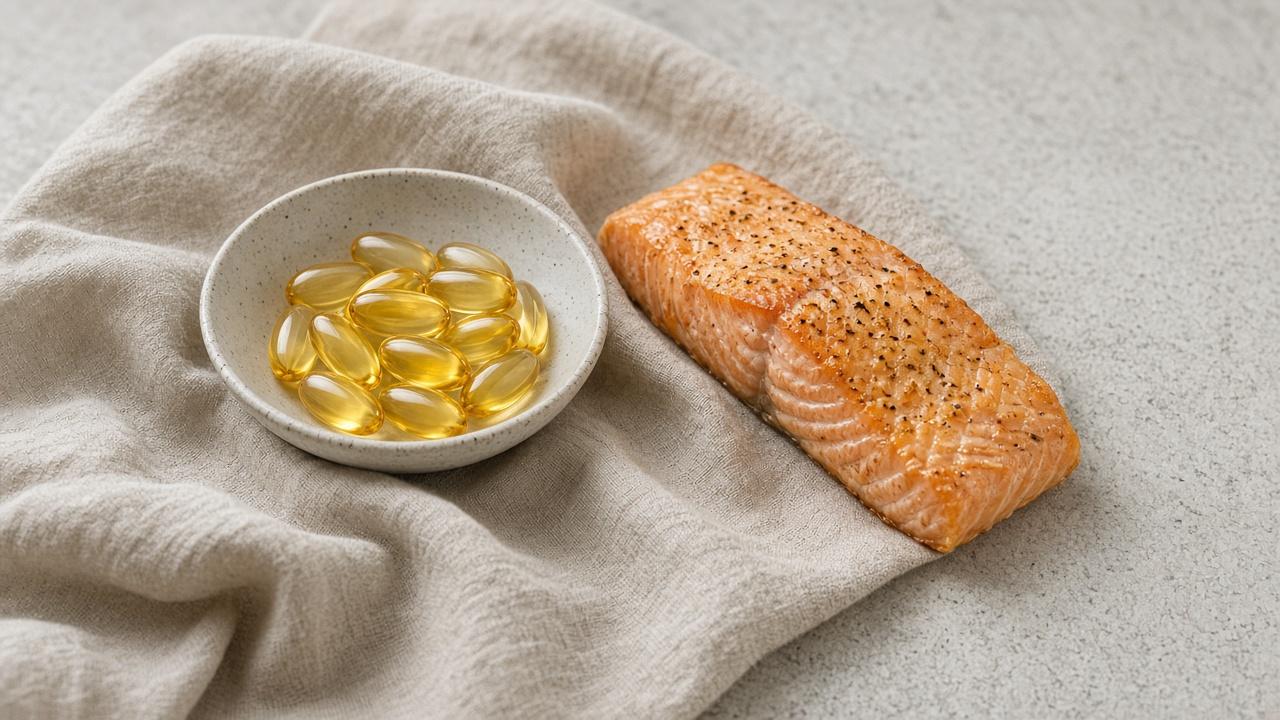
Among 1,228 adults on hemodialysis, 4 grams a day of fish oil, versus corn oil, went with a lower rate of serious cardiovascular events over 3.5 years, hazard ratio 0.57. The dose is a capsule, larger than 100 g of king salmon, and no fish row changes.
Published · Sources checked 26 Nov 2026 · By Assize Index
Summary
- Background.
- Fish oil is often discussed as if it were the same thing as eating fish. A large 2025 trial tested the capsule in people on hemodialysis.
- What we found.
- The fish-oil group had 0.31 serious cardiovascular events per 1,000 patient-days, against 0.61 on corn-oil placebo. Hazard ratio 0.57, 95% CI 0.47 to 0.70. The capsule supplied 2.4 g a day of EPA plus DHA.
- What it means.
- The result belongs to that dose and that population. Cooked king salmon has about 1.7 g of EPA plus DHA in 100 g. The trial does not move a row on the fish table.
Who was in the trial
Cardiovascular disease is the leading cause of death for people on hemodialysis, and it has been unclear whether fish oil changes that. A trial in the New England Journal of Medicine, published online on 7 November 2025, tested a daily fish-oil capsule against a corn-oil placebo in adults on maintenance dialysis in Canada and Australia1.
It was double-blind and randomized, at 26 sites. Of 1,228 people, 610 received fish oil and 618 received placebo. The fish oil was 4 g a day of omega-3 fats: 1.6 g of EPA and 0.8 g of DHA, which is 2.4 g of those two together. Follow-up ran about 3.5 years. People entered the trial between November 2013 and July 2019.
What happened
| Fish oil | Corn-oil placebo | |
|---|---|---|
| People randomized | 610 | 618 |
| Serious cardiovascular events, per 1,000 patient-days | 0.31 | 0.61 |
| Hazard ratio | 0.57 (95% CI 0.47 to 0.70) | — |
The primary result was a lower rate of serious cardiovascular events on fish oil: hazard ratio 0.57, P < 0.001. That composite included cardiac death, heart attack, stroke, and peripheral vascular disease that led to amputation. The paper also reports lower hazard ratios for cardiac death (0.55), heart attack (0.56), and stroke (0.37). Adherence and the rate of adverse events did not meaningfully differ.
A hazard ratio of 0.57 is a large relative difference inside this trial. The people in it were on dialysis. The comparison was a capsule against corn oil, not a piece of fish against no fish. The result does not transfer, by itself, to a healthy adult choosing salmon at a shop.
The capsule next to a piece of fish
The daily capsule delivered 2,400 mg of EPA plus DHA. Cooked wild king salmon on our table has 1,737 mg in 100 g2. The capsule is more long-chain omega-3 than that 100 g piece, taken every day, in a population with a very high rate of cardiovascular events. Eating fish a few times a week is a different exposure, and this trial did not test it.
What stays on the table
No fish row changes. The omega-3 amounts in food are a separate compilation, and the pregnancy guidance is still the mercury chart. This paper is evidence about a high-dose capsule in hemodialysis. It is not a reason to rewrite a fillet, and it is not advice to start a supplement. The food amounts are on the omega-3 chart.
Table impact
None. The trial tested a capsule in people on hemodialysis, not a fish on the table. No row moves.
On our tables
References
- Lok C., Farkouh M., Hemmelgarn B., et al. Fish-oil supplementation and cardiovascular events in patients receiving hemodialysis. New England Journal of Medicine, published online 7 November 2025. doi.org/10.1056/NEJMoa2513032
- USDA FoodData Central, SR Legacy FDC 171999: fish, salmon, chinook, cooked, dry heat. EPA plus DHA from that composition row. fdc.nal.usda.gov/food-details/171999/nutrients
Declaration of interests
Assize Index takes no payment or commission from any product or brand named here.
Cite this
Assize Index. What did a large fish-oil trial in dialysis patients find? Behind the Table, 18 Feb 2026. assizeindex.com/behind-the-table/fish-oil-trial-in-hemodialysis Reuse terms
Data, not medical advice. For decisions about your own health, talk with a clinician.